


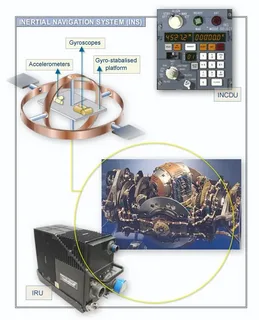
In modern aerospace, defense, marine, and autonomous systems, navigation must remain reliable even when GPS signals are weak or unavailable. This is where an Inertial Navigation System (INS) plays a critical role. However, understanding Inertial Navigation System Accuracy: Factors That Matter Most is essential because even small errors can accumulate over time and significantly affect performance.
What Is an Inertial Navigation System?
An Inertial Navigation System (INS) is a self-contained navigation technology that calculates position, velocity, and orientation using motion sensors such as accelerometers and gyroscopes. Since it does not rely on external signals, it is widely used in submarines, aircraft, missiles, spacecraft, and autonomous vehicles.
However, the effectiveness of any INS depends heavily on its accuracy, which is influenced by multiple technical and environmental factors.
Inertial Navigation System Accuracy: Factors That Matter Most
When analyzing Inertial Navigation System Accuracy: Factors That Matter Most, it becomes clear that no single element determines performance. Instead, accuracy depends on a combination of sensor quality, calibration, algorithms, and operating conditions.
1. Sensor Quality and Precision
The heart of any INS is its sensors.
- Gyroscopes measure angular velocity
- Accelerometers measure linear acceleration
High-grade fiber-optic or ring laser gyroscopes offer far better stability than low-cost MEMS sensors. Even tiny biases or noise in sensors can lead to drift over time, reducing overall navigation accuracy.
2. Error Accumulation and Drift
One of the biggest challenges in INS technology is drift. Since the system continuously integrates acceleration and rotation data, even small measurement errors compound over time.
This is why Inertial Navigation System Accuracy: Factors That Matter Most always includes error modeling and compensation techniques. Without correction, positional errors can grow from meters to kilometers in long-duration missions.
3. Calibration and Alignment
Proper calibration ensures that sensors are correctly tuned before operation. Misalignment between sensor axes or incorrect initialization can introduce systematic errors.
Modern systems use:
- Factory calibration
- In-field alignment procedures
- Real-time self-correction algorithms
These methods significantly improve navigation reliability.
4. Environmental Conditions
External conditions can also impact performance:
- Temperature changes can affect sensor sensitivity
- Vibrations from engines or turbulence introduce noise
- Magnetic interference (in hybrid systems) may distort readings
Understanding these factors is essential when evaluating Inertial Navigation System Accuracy: Factors That Matter Most, especially in harsh operational environments like aerospace or underwater missions.
5. Integration with Other Navigation Systems
Pure INS systems degrade over time, which is why they are often combined with GPS, GNSS, or visual navigation systems. This hybrid approach helps correct drift and improves long-term accuracy.
Sensor fusion techniques, such as Kalman filtering, are widely used to merge multiple data sources and enhance performance.
6. Software Algorithms and Processing Power
Advanced navigation software plays a major role in improving accuracy. Modern INS units rely on:
- Real-time filtering algorithms
- Error correction models
- Machine learning-based drift compensation (in newer systems)
Without strong computational algorithms, even the best hardware cannot achieve optimal performance.
Conclusion
The overall performance of any navigation system depends on a balance between hardware precision and intelligent software design. As seen throughout this discussion of Inertial Navigation System Accuracy: Factors That Matter Most, key influences include sensor quality, drift behavior, calibration methods, environmental conditions, and sensor fusion techniques.
In real-world applications, achieving high accuracy is not about eliminating all errors but about continuously managing and correcting them to maintain reliable navigation over time.
